
Content
The Heart of the Problem: What Is Nuclear Waste?
When we talk about “nuclear waste,” we’re usually referring to high-level waste (HLW). This is primarily the “spent fuel” from nuclear reactors. After uranium fuel rods have been used to generate electricity for several years, they are no longer efficient, but they have become intensely radioactive. This material contains fission products and transuranic elements, like plutonium, that can remain dangerously radioactive for tens of thousands, or even hundreds of thousands, of years. While power plants also produce low-level and intermediate-level waste (like contaminated tools, clothing, and components), it is the high-level waste that forms the core of the storage dilemma. Its combination of intense heat, extreme radiation, and incredible longevity makes it unlike any other industrial byproduct on Earth. Storing it requires isolating it from the entire biosphere—water, air, and life—for a timeframe longer than human civilization has existed.The Case for Manageability (The “Pro” Argument)
Proponents of nuclear energy argue that the waste problem, while serious, is a manageable engineering challenge. They contend that the benefits of massive, reliable, zero-emission electricity far outweigh the risks, which they believe can be mitigated by technology. Their arguments rest on a few key pillars.Deep Geological Repositories (DGRs)
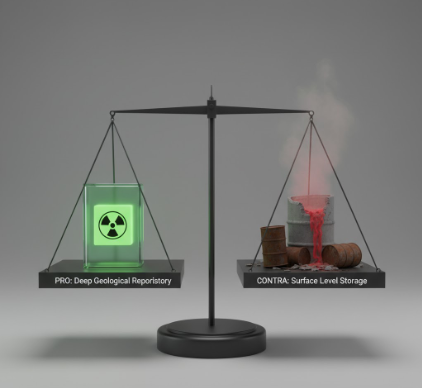
The international scientific consensus is that the safest permanent solution for high-level waste is burial in deep geological repositories (DGRs). The concept is to place the waste hundreds or thousands of meters underground in extremely stable geological formations, such as solid granite, clay, or deep salt domes. These rock formations have been stable for millions of years, suggesting they will remain so for the 100,000-plus years required. This method relies on a “multi-barrier” approach. First, the waste itself is often vitrified—mixed with molten glass and solidified into a stable, durable log. Second, these glass logs are placed inside incredibly robust, corrosion-resistant casks, often made of copper or specialized steel. Third, the tunnels and shafts of the repository are backfilled with highly compacted clay (bentonite) which swells when wet, sealing any cracks. The final, and most important, barrier is the rock itself, which isolates the waste from groundwater. Countries like Finland (with its Onkalo facility) and Sweden are already constructing these repositories, portraying them as a definitive, long-term technical solution.Reprocessing and Advanced Reactors
Another argument is that the “waste” isn’t entirely waste at all. Spent fuel rods still contain a significant amount of usable uranium and plutonium. Through a process called reprocessing, these materials can be chemically separated and fabricated into new fuel. Countries like France and Japan have long practiced reprocessing. This doesn’t eliminate waste, but it dramatically reduces its volume (by about 80%) and can lower its long-term toxicity. The resulting high-level waste is still hazardous, but there’s simply less of it to manage. Furthermore, proponents point to the future: new generations of reactors. Advanced designs, like Small Modular Reactors (SMRs) or Molten Salt Reactors, are being developed with waste in mind. Some are designed to “burn” existing waste from conventional reactors, using it as fuel and transmuting the long-lived elements into shorter-lived, more manageable isotopes.The Case Against Current Solutions (The “Contra” Argument)
Opponents of nuclear power view the waste problem as its fatal flaw. They argue that no technical solution can ever be 100% guaranteed over the vast timescales required, and that the risks—both environmental and social—are simply too high. Their arguments are rooted in uncertainty, human fallibility, and social ethics.The “Not In My Backyard” (NIMBY) Problem
The single biggest hurdle for DGRs is not engineering; it’s politics. No community wants to be the world’s nuclear dumping ground. The “Not In My Backyard” (NIMBY) phenomenon is universal. Finding a location that is both geologically perfect and politically willing is almost impossible. The decades-long, multi-billion dollar saga of the Yucca Mountain repository in the United States is a prime example. After decades of scientific study, the project was effectively canceled due to immense political and social opposition from the state of Nevada. This political stalemate is the direct cause of the current, and perhaps most dangerous, situation. With no permanent repository to send it to, high-level waste is currently stored “temporarily” at the power plants where it was created, often in massive cooling pools just waiting for a final solution that never seems to arrive.The 100,000-Year Gamble
Critics of DGRs ask a simple question: Can we really predict the future 100,000 years from now? We are placing our trust in containers not to leak, geology not to shift, and future civilizations not to accidentally disturb these sites. What about future ice ages, major earthquakes, or changes in groundwater flow over millennia? We are making a 100,000-year gamble based on geological models that, while advanced, are still just models. There’s also the risk of transportation. To get to a central repository, thousands of shipments of the most dangerous material on earth would have to travel across the country’s roads, rails, and waterways. Critics argue that each shipment is a potential target for attack or a source of a catastrophic accident.The current network of “temporary” storage facilities, primarily at reactor sites, was never engineered for permanent containment. These sites, especially the densely-packed cooling pools, remain a significant vulnerability. A failure of cooling systems or a successful attack could have catastrophic consequences. This makes the search for a permanent solution not just a technical challenge, but an urgent security imperative.
Interim Storage: The Current Reality
Because the debate over permanent storage has been deadlocked for decades in most countries, the world has defaulted to “interim storage.” This is the state we are in now, and it takes two primary forms:- Wet Storage (Cooling Pools): When spent fuel rods are first removed from a reactor, they are intensely hot and radioactive. They are immediately submerged in deep pools of circulating, borated water. The water serves to both cool the fuel and block the radiation. These pools were only ever designed to hold fuel for a few years until it could be sent for reprocessing or permanent disposal.
- Dry Cask Storage: After cooling in the pools for 5-10 years, the fuel can be moved to “dry cask” storage. These are massive, air-cooled containers made of thick steel and concrete. They are sealed and placed on a concrete pad at the power plant site. This is widely considered a much safer and more secure method for interim storage (decades) than pools, but it is still not a permanent solution.


